Cold-water swimming: what happens to your body in icy water
Why do people plunge into icy water, does it really strengthen your health, and why does climbing out of an ice hole not mean your body has stopped cooling? We look at what the science says.
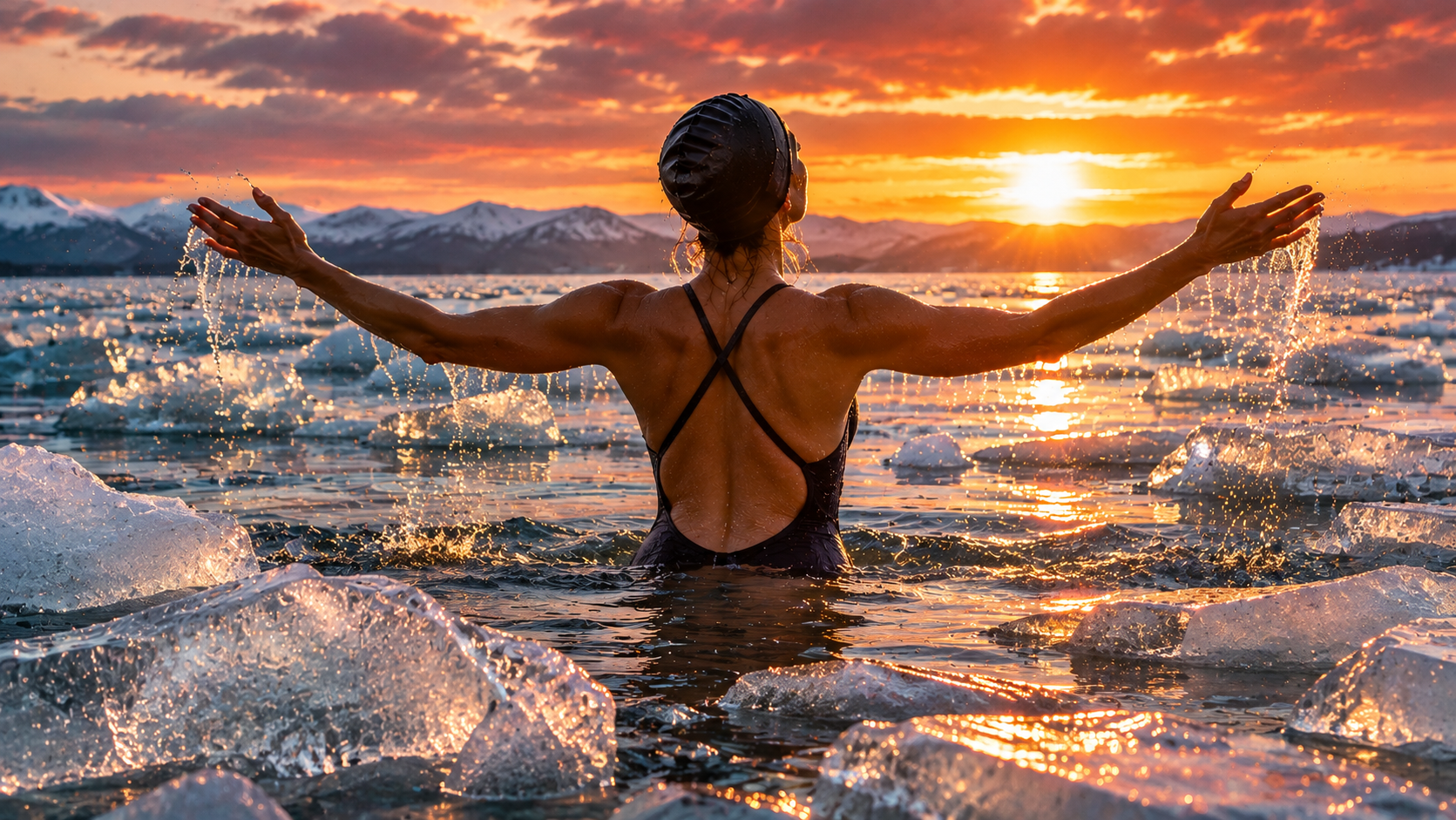 Image generated by AI
In recent articles, Second Breath has returned to the subject of cold water more than once. We wrote about the people who swim all year round in Aktau and introduced readers to Evgenia Savoskina, for whom cold water has become part of life.
Today we have a reason to turn to the theory. 24 November is Walrus Day. The date was originally established in 2008 to draw attention to the protection of marine mammals, but over time winter swimmers adopted it too. This year, for example, the All-Russian Winter Swimming Federation timed a week-long cold-hardening campaign to coincide with it.
So what does modern medicine actually know about cold-water swimming?
Ice dipping, winter swimming and cold hardening: what’s the difference?
These terms are often used interchangeably, although the strain they put on the body can differ considerably.
Ice dipping
The common name for regularly bathing in, or briefly immersing yourself in, cold or even icy water. Covering a distance is not required.
Winter swimming
Swimming in open water during the cold season, whether for health, as a hobby or as a sport.
Ice swimming
Ice Swimming · 5 °C and belowA competitive discipline with races held in water of 5 °C and below.
Cold hardening
A broader concept: gradually adapting the body to environmental factors, including cold.
Contrast therapy
Alternating heat and cold — for example, a sauna and an ice hole.
There is no strict, universal medical classification of cold-water swimming. So someone who regularly dips into an ice hole after the sauna can quite fairly call themselves a winter swimmer. Physiologically, however, contrast therapy and a plunge into cold water on its own affect the body in different ways.
What happens to the body in cold water?
Cold shock
The body’s first reaction to sudden immersion in cold water is known as the cold shock response.
Marked physiological reactions can occur even when the water is around 15 °C. This is not only about an ice hole.
Putting your face in the water and holding your breath at this moment is especially risky. Triggering two opposing reflexes at once — the cold shock response and the diving reflex — can lead to heart rhythm disturbances. In the scientific literature this is called autonomic conflict.
Regular cold adaptation can reduce the severity of cold shock, but it does not remove the risks completely.
Loss of muscle performance
As the body cools, the muscles and peripheral nervous system work less well. Strength, sensation and coordination all decline.
It can become harder to make swimming strokes, hold on to a ladder rail, undo your clothes or get out of the water unaided.
What’s more, the ability to swim can fail before general hypothermia sets in.
Cooling continues even on the shore
One feature of being in cold water is the afterdrop effect: core body temperature can keep falling even after contact with the cold water has ended.
- 1Leaving the water
- 2Afterdrop: the temperature keeps falling
- ↗Gradual rewarming
A schematic illustration of a physiological process, not measurements from a specific person.
This is due to continuing heat exchange between the core and the chilled peripheral tissues, as well as changes in blood circulation.
The International Ice Swimming Association (IISA) specifically stresses the need to monitor athletes after they finish. Severe hypothermia can show itself once a swimmer is already on the shore, even in experienced swimmers.
From the ice hole straight into the sauna: is it safe?
Alternating the sauna and cold water is a centuries-old tradition, especially widespread in the Scandinavian countries. But a tradition alone does not guarantee that the practice is safe for everyone.
Cold
Blood vessels narrow.
Heat
Blood vessels widen.
Sudden temperature changes are accompanied by changes in circulation, blood pressure and heart rate.
Intensive rewarming of someone who has already developed hypothermia is particularly dangerous. It can be followed by a further fall in core body temperature, a drop in blood pressure and loss of consciousness.
The Wilderness Medical Society’s clinical guidelines advise against using a warm bath or shower as the initial method of rewarming in hypothermia. The International Ice Swimming Association also warns about the risks of rewarming athletes too quickly.
Does this mean going to the sauna after any short dip is strictly forbidden? No. A brief contrast session and rewarming after prolonged cold exposure are different situations.
However, a sauna should not be seen as a universal first-aid remedy for hypothermia.
Is cold-water swimming really good for your health?
In January 2025 the scientific journal PLOS ONE published a systematic review and meta-analysis of studies on how cold-water immersion affects the health and wellbeing of adults.
Cain T. et al. Effects of cold-water immersion on health and wellbeing. Read the original study
The results were mixed.
It is important to bear in mind that the studies mostly used cold baths and showers. Their results therefore cannot simply be applied to regular swimming in open water at temperatures close to freezing.
Another systematic review, published in 2026, assessed the effect of contrast therapy on cardiovascular and metabolic health. The authors analysed 21 studies and concluded that there is not yet enough evidence of a lasting positive effect on blood pressure, blood vessel health or metabolism.
So the feeling of energy and wellbeing that many cold-water enthusiasts describe may well be real. But it is too early to regard cold-water swimming as a proven way to prevent disease or prolong life.
Can you take up cold-water swimming after 40, 50 or 60?
Age on its own is not an absolute contraindication. Plenty of winter swimmers are older people.
However, the likelihood of cardiovascular disease — including undiagnosed conditions — increases with age. Some medicines can also affect how the body responds to cold.
It is especially important to consult a doctor beforehand if you have coronary heart disease, heart rhythm disorders, uncontrolled high blood pressure or other chronic conditions.
At the same time, being fit is not the same as being adapted to cold. Even an experienced marathon runner or swimmer may be unprepared for a sudden plunge into icy water.
Key safety rules
Adapt gradually
Don’t start your acquaintance with cold water by plunging into an ice hole.
Never swim alone
Someone who can help must be close by.
Don’t jump or dive in
Enter the water in a controlled way. Avoid deliberate hyperventilation and breath-holding.
Don’t measure yourself against other people’s records
There is no universally safe length of time to stay in cold water.
Have dry clothes ready
When you get out, take off wet clothing, get out of the wind and go somewhere warm.
Avoid alcohol
It creates a false sense of warmth and impairs your judgement of your own condition.
Listen to your body
Don’t try to push through chest pain, dizziness, loss of coordination or marked weakness.
Cold water is not a requirement for good health
Today, science has far stronger evidence for the benefits of regular physical activity than for the benefits of cold-water swimming.
Cold water can become a fascinating hobby, a way to vary your training, part of a sporting culture or a reason to find like-minded people. But it is not an essential part of a healthy lifestyle.
And if you decide to join the winter swimming community, let your main measure of progress be not the number of minutes in the ice hole or the lowest water temperature, but the ability to do what you love without unjustified risk to your health.
Scientific sources and medical guidelines
- Cain T. et al. (2025). Effects of cold-water immersion on health and wellbeing: A systematic review and meta-analysis. PLOS ONE.
- Knechtle B. et al. (2020). Cold Water Swimming — Benefits and Risks: A Narrative Review. International Journal of Environmental Research and Public Health.
- Tipton M. et al. (2022). Cold water therapies: minimising risks. British Journal of Sports Medicine.
- International Ice Swimming Association (2024). Swimming Medical and Safety Guidelines.
- Wilderness Medical Society (2019). Clinical Practice Guidelines for the Out-of-Hospital Evaluation and Treatment of Accidental Hypothermia.
- American Heart Association (2022). The plunge into cold water comes with risks.
- American Heart Association and American Red Cross (2024). Guidelines for First Aid.
- Experimental Physiology (2026). Cardiometabolic effects of contrast therapy: A systematic review.