We bought a home gym and got a clothes horse
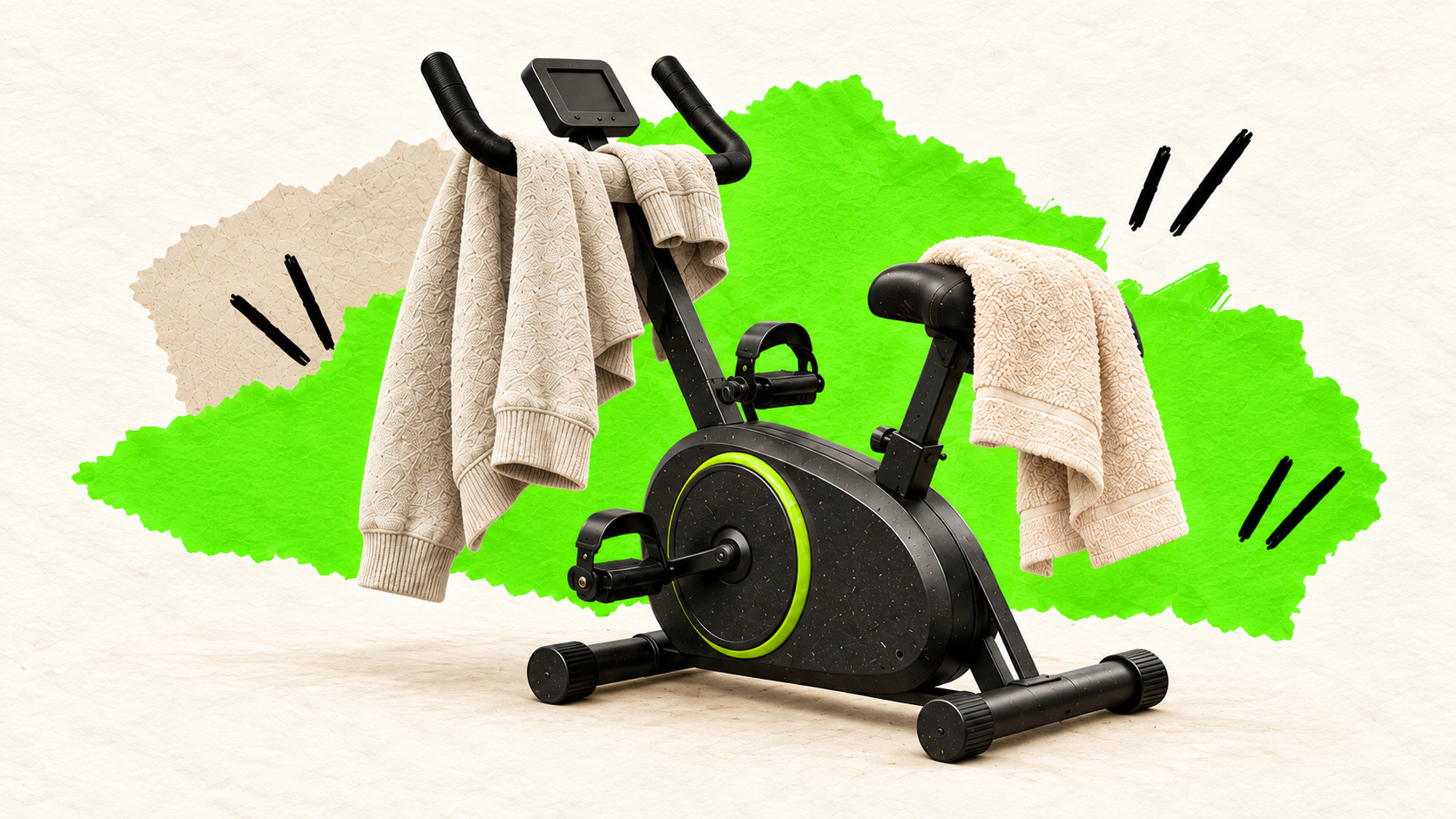
The exercise bike has acquired a new function: it’s handy for drying towels. The mat is behind the wardrobe. The resistance bands are in the little bag they arrived in from the shop. Everything works. It just isn’t used. When we bought it all, the plans were different. Work out in the mornings, strengthen your back, add more movement to the working day. It seemed all you had to do was get the right kit — and start. So why does so much time sometimes pass between “buying” and “using”?
People regret purchases. Sporting ones too
In the shop it’s easy to imagine: a workout in the morning, stretching in the evening, cycling at the weekend. But we’re the ones who will have to use it all — with work, children and the urge to have a lie-in.
Researchers Robin Tanner and Kurt Carlson found a curious pattern: when predicting how much they would exercise in future, people gave roughly the same estimates as participants who were asked to imagine ideal conditions.
So in our plans we may quietly remove everything that usually gets in the way of exercising. And then buy equipment to fit that convenient schedule. This doesn’t explain every forgotten dumbbell. But it’s a reason to ask yourself: am I buying this for my everyday life, or on the assumption that I’ll first change that life completely?
A good thing can still be one too many
In a British study of purchases, just over 40% of people who had bought sports equipment and gear, including bicycles, said they had at some point regretted a purchase in this category. That’s a share of people, not a share of abandoned items. Regret doesn’t necessarily mean the purchase was never used.
Sometimes a thing works and is convenient, but just doesn’t suit you. Working out at home can turn out to be boring. There may be no suitable route for the bike. And the exercise machine has to be dragged out from behind the wardrobe and assembled every time.
These are possible everyday situations, not survey findings. But they help you look at a purchase without the usual “I just don’t have enough discipline”. What exactly is stopping you from using it? “Laziness” doesn’t explain much. “It takes twenty minutes to clear the space” is a clear problem.
Money spent won’t make a schedule
A similar gap between plans and actions was found by economists who studied attendance at three American health clubs.
In data on 7,752 members, people paying a flat monthly fee of more than $70 went on average 4.3 times a month. At that rate, a pack of pay-per-visit passes would have been cheaper. One of the explanations the authors consider is that people overestimate how often they will go in future.
The study is about gym memberships, not home exercise equipment. But the question before spending is the same: how often will I actually use this?
Work out the cost of one workout
Let’s say the equipment costs 120,000 tenge.
Number of times used
Cost per use
10
12,000 tenge
50
2,400 tenge
100
1,200 tenge
This is a rough calculation: it leaves out maintenance, extra costs and possible resale. It doesn’t tell you which purchase is the “right” one. But it helps you compare options — for example, owning equipment versus hiring it.
For a forecast, it’s more useful to take a workout frequency that already fits into your life. Four workouts a week will give you an attractive cost per use. The question is whether those four workouts will actually happen.
The money you’ve already spent won’t come back just because the thing stands in the corner for another year. But you can decide what use it will be from now on — to you or to someone else. A bad purchase doesn’t make the attempt to take up sport a failure. Perhaps you simply learned something about yourself that you didn’t know at the till.
Or perhaps, as you were reading, you remembered something perfectly suitable that’s long overdue to be put back to work.
What is it in your case — a mat, a bike, dumbbells? And what one action will help you work out whether you need it today?
Sources
- Skelton A. C. H., Allwood J. M. Questioning demand: A study of regretted purchases in Great Britain. Ecological Economics, 2017, 131: 499–509. An analysis of responses from 1,995 adults in Great Britain; the survey was carried out in 2015. Full text.
- Tanner R. J., Carlson K. A. Unrealistically Optimistic Consumers: A Selective Hypothesis Testing Account for Optimism in Predictions of Future Behavior. Journal of Consumer Research, 2009, 35(5): 810–822. Publication.
- DellaVigna S., Malmendier U. Paying Not to Go to the Gym. American Economic Review, 2006, 96(3): 694–719. Publication.
The studies were carried out outside Kazakhstan and do not describe how common such purchases are among amateur athletes in Kazakhstan. The checklist and suggestions for sorting out your equipment were prepared by the editorial team; their effectiveness was not tested in the studies listed.